Відкрита Книга
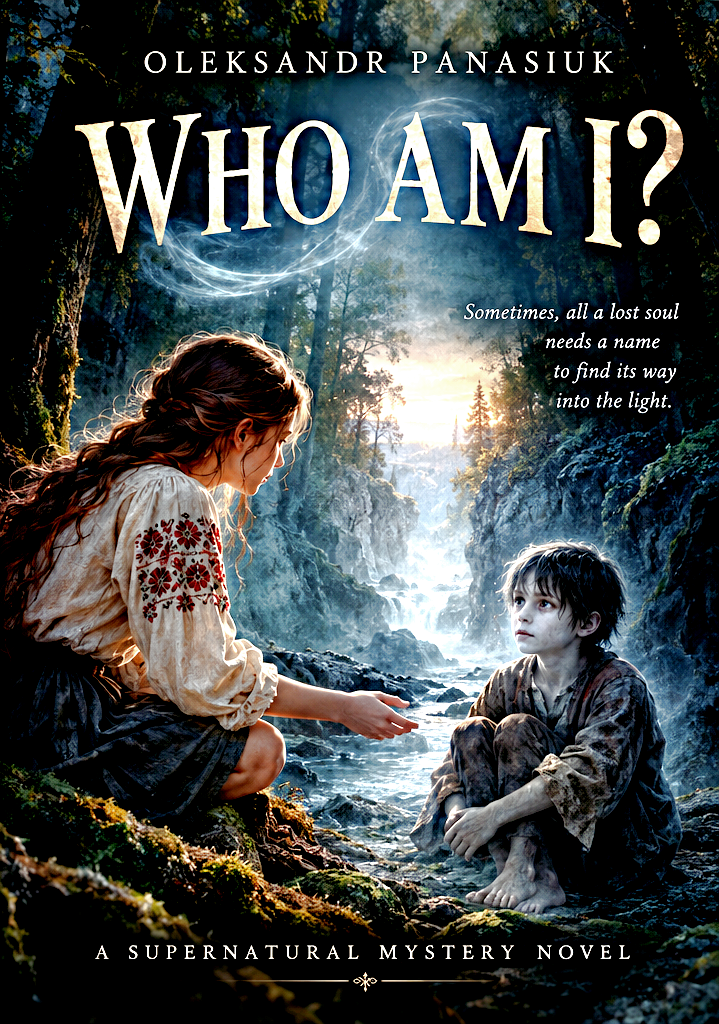
WHO AM I?
PROLOGUE
The Deep Ravine
In early June 1945, the war was over, but the village still dared not speak of peace.
Not all the men had returned from the front. In many homes, all that remained of them were death notices folded into quarters. Shell craters scarred the vegetable gardens, half-filled trenches lay behind the old school, and now and then exhausted soldiers passed along the road, not yet knowing where they were supposed to go.
That morning Marfa Kovalchuk ran out of her house barefoot, wearing nothing but a linen shift.
“The Germans!” she screamed. “Dear God, the Germans have come back!”
Seven armed Nazi soldiers had appeared at dawn. They were filthy and unshaven, their uniforms in tatters. They took bread, lard, two jugs of milk, and an old sheepskin coat from Marfa’s house. When she tried to snatch a little bundle of flour from one of them, he struck her with the butt of his rifle.
After that, the strangers headed toward the old forest.
Several hours later, soldiers arrived from the district center. Three local men who knew the forest paths joined them. The oldest was Matviy, a taciturn, gray-haired hunter whose face was covered in scars.
When the commander pointed toward the forest, Matviy shook his head.
“If they went toward the marsh, we’ll find them,” he said. “If they made for the rocky hill, we’ll find them there too.”
“And if they went into the ravine?” one of the villagers asked. The hunter gave him a look that silenced him at once.
The Deep Ravine lay several miles beyond the village. Ancient oaks grew so close together there that the ground remained in shadow even at noon. Thick moss covered their trunks, and their twisted roots rose out of the earth like enormous fingers.
A narrow stream ran along the very bottom of the ravine. Its water was clear and icy cold even in the hottest summer weather. People said it sprang not from beneath the earth, but from another world.
Long ago, villagers had gone to the spring to draw water. Then livestock began disappearing in the ravine. A shepherd searching for a lost heifer vanished. Two hunters never returned. And one autumn night, the people living on the outskirts of the village heard a child crying in the forest.
From then on, even the bravest tried to give the place a wide berth.
Nobody spoke of the ravine by day; after sunset, people were afraid even to say its name.
The search went on for two days.
They found broken branches, heavy boot prints, and scraps of German uniform. Marfa Kovalchuk’s empty milk jug lay beside an old pine. A little farther on, they found a half-eaten loaf of bread.
It looked as though the fugitives had suddenly abandoned their food and fled.
But no one knew what they had been running from.
On the third day, a dog brought by the soldiers led the search party to the edge of the Deep Ravine. There it stopped, whined, and pressed its belly to the ground.
The handlers tugged at its leash and ordered it forward, but the dog fought to get away, buried its muzzle in the grass, and trembled uncontrollably.
“There’s something down there,” the commander said.
Matviy knelt and touched the earth. Tracks left by seven men led down the slope.
Not a single track led back up.
“We’ll wait until morning,” the commander decided.
They set up camp nearby, lit a fire, and posted sentries. The night was warm and still, but around midnight such a bitter cold rose from the ravine that white frost formed on the grass.
A young soldier was the first to hear a child laughing. He lifted his head and listened.
“There’s a child out there.”
“What child?” his companion grumbled.
The laughter came again out of the darkness. Soft, clear, and very close.
Then a twig snapped.
A small white figure flashed between the trees. The sentry grabbed his rifle.
“Halt! Who goes there?”
With a single movement, Matviy knocked the weapon from his hands.
“Don’t call out!” he whispered. “And whatever you hear, don’t answer.”
At that very moment, a gunshot rang out from deep in the forest.
Crows erupted from the treetops. The black flock circled the ravine several times before vanishing into the darkness.
No one slept for the rest of that night.
At dawn, a thick, milky fog hung over the ravine. The search party descended slowly, staying close together. Wet leaves slipped beneath their boots. The ancient oaks stood like giants, their heavy branches interlaced overhead, shutting out the morning sun.
The farther down they went, the colder it became.
At the bottom of the ravine, they found the Germans.
All seven were dead.
One lay beside the stream with his hand submerged in the icy water. Another sat beneath an oak, his knees drawn up to his chest. A third had clapped his hands over his ears. One had managed to draw his pistol, but instead of firing at an attacker, he had shot high into a tree.
The others lay nearby.
There were no bullet wounds or knife wounds on their bodies. No one had strangled or beaten them. Their weapons, food, and ammunition were still with them.
Yet the faces of the dead silenced even the men who had survived the entire war.
Their mouths hung open in soundless screams. Their eyes stared ahead as though, just before dying, they had seen something that should never have existed in this world.
The youngest German lay at the roots of a gigantic oak. His fingers had been scraped bloody: before he died, he had desperately clawed at the earth.
Something small and pale showed in the shallow hole. The commander bent down.
“Don’t touch it,” Matviy said.
But the commander had already picked it up.
It was a wooden horse with one leg broken off. Old and blackened by the soil, it might have lain beneath the oak for years. And then a cry came from under the roots.
A tiny cry, almost like a newborn baby’s.
The men stepped back. Someone crossed himself. The young soldier dropped his rifle.
The crying stopped abruptly.
On the far side of the stream, a little barefoot boy stood in the fog. He wore a long white shirt. Wet hair clung to his forehead, and his lips, blue with cold, barely moved.
Matviy stared at him without blinking.
The others could make out only a vague white shape.
“Mama…” the child whispered. The boy reached out his arms.
The commander took a step toward him, but the hunter seized his shoulder.
“Don’t go.”
The child slowly raised his head.
Large, sorrowful dark eyes stared out of his pale face.
“Who am I?” the boy asked. No one answered.
The fog shifted, veiled the child, and he vanished.
The men carried seven bodies out of the ravine. The wooden horse, the child’s crying, and the little boy were never mentioned in the report.
Matviy returned home looking years older, his hair gone gray. For the rest of his life he never entered the old forest again, and he never told anyone what he had seen beneath the oak.
Once more, the villagers kept their distance from the Deep Ravine.
Years passed. New houses rose, children were born, and the last witnesses of the war died. The old story became a frightening village legend.
But the boy beneath the ancient oak had not gone anywhere.
He was cold. He cried. And he waited.
He waited for someone who would be able to see him.
For someone who would finally answer his one question:
“Who am I?”